

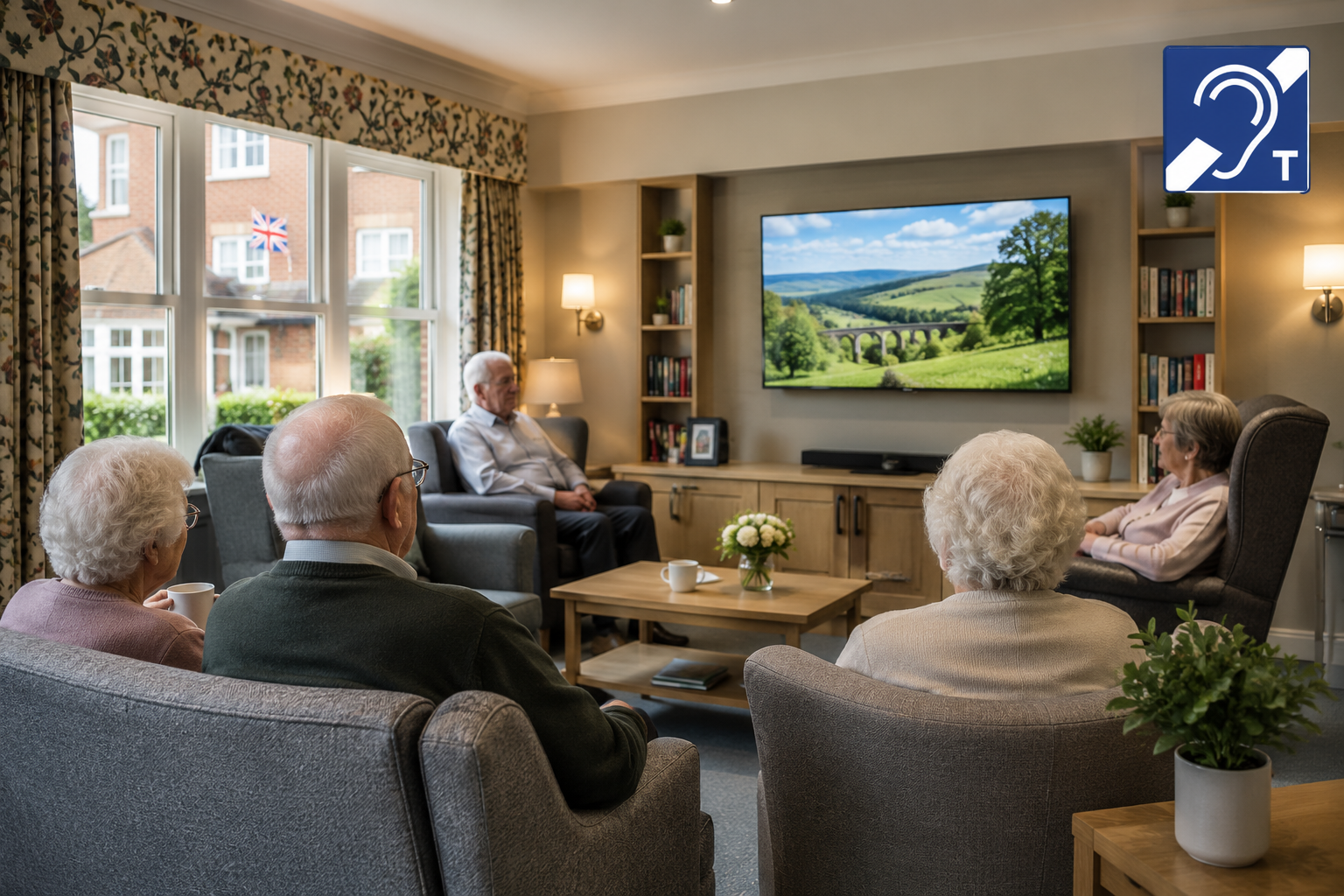
Assistive audio for care settings
Hearing Loops & Assistive Audio
Clear audio helps residents take part in conversations, activities, family visits and daily routines. Altus designs, installs and maintains assistive audio around the care environment.
for connected care technology
Lower cost & complexity
across suppliers, systems and support
Better outcomes
for service levels, resident safety and visibility

How Altus helps
Make accessibility practical, reliable and easier to evidence.
Altus helps residents hear clearly while reducing the operational friction of dealing with separate installers, suppliers and maintenance routes.
Hearing Loop Systems
Room-specific loop design and installation for lounges, dining rooms, reception spaces and activity areas.
- IEC 60118-4 aligned approach
- Coverage planned by room
- Commissioning and testing
Bluetooth Broadcast Audio
Support for emerging assistive listening options as hearing aid technology moves forward.
- Future-ready planning
- Portable receiver options
- Clearer group listening
Managed Compliance
Assistive audio should keep working after installation, with ownership for maintenance and evidence.
- Ongoing checks
- One point of contact
- CQC-ready records
Hearing loops explained
Hearing loop questions care providers ask
Planning a project? Read our full guide: Hearing loops in care homes: a buyer’s guide.
| Option | Best for | Watch out for |
|---|---|---|
| Perimeter loop | Single lounges, dining rooms and activity rooms | Signal can spill into rooms next door, and metal in floors can weaken coverage |
| Low-spill (phased array) loop | Rooms side by side, or spaces where conversations should stay private | More design and installation work than a simple perimeter loop |
| Counter or portable loop | Reception desks, nurse stations and one-to-one conversations | Covers a small area only |
| Bluetooth broadcast audio (Auracast) | Residents with newer hearing aids or earbuds that support it | Many existing hearing aids do not support it yet, so plan it alongside loops, not instead of them |
What is a hearing loop and how does it work in a care home?
A hearing loop is a cable around a room, driven by an amplifier, that carries sound as a magnetic signal. Residents with hearing aids set to the T (telecoil) setting hear the speaker directly, without the background noise of a busy lounge, dining room or activity session.
Do care homes have to provide hearing loops?
The Equality Act 2010 expects service providers to make reasonable adjustments for disabled people, and hearing loss is one of the most common disabilities among older residents. CQC also looks at whether people are supported to communicate. A working loop in shared spaces is one of the simplest ways to show both.
Which rooms in a care home need a hearing loop?
Start with the rooms where residents listen as a group or talk to staff: lounges, dining rooms, activity and cinema rooms, reception and any room used for family visits or reviews. A survey of each room decides the loop type, because room size, metal in the building and neighbouring rooms all change the design.
What standard should a care home hearing loop meet?
Loop performance is measured against IEC 60118-4, and BS 7594 is the UK code of practice for design, installation and maintenance. A compliant system is commissioned with measurements, handed over with a certificate and tested again on a regular schedule and after any building work.
Why do hearing loops stop working?
Most failures are simple: an amplifier switched off or unplugged, a damaged cable after redecoration, a microphone that nobody uses, or staff who do not know the loop exists. Regular checks, clear signage and a short staff briefing keep a loop useful long after installation.
Will Bluetooth broadcast audio replace hearing loops?
Not yet. Bluetooth broadcast audio, known as Auracast, lets compatible hearing aids and earbuds join a room audio stream. Many residents use hearing aids that do not support it, so most care settings should keep loops in place and plan broadcast audio as an addition when hearing aids are replaced.
Care technology review
Reduce cost, improve service levels and make care technology easier to manage.
Altus reviews your current systems, supplier model and support gaps, then gives you practical ways to reduce duplication, improve resident safety and strengthen outcomes.